Introduction: Launching a Taxi Booking Business in 2026
Planning to launch a ride-hailing platform? Uber clone app development gives entrepreneurs and transport operators a practical starting point for building a branded taxi booking experience. A successful platform needs more than an attractive passenger app: it also needs reliable driver workflows, dispatch logic, payments, support, and operational controls.
In this guide, we explain the essential features, development process, technology options, indicative costs, and business decisions involved in creating an Uber-like taxi booking app. Explore SMR Softech's Uber clone app development solutions if you are considering a custom project.
What Is an Uber Clone App?
An Uber clone app is a ride-hailing platform inspired by the core booking and dispatch model used by popular taxi apps. It is not necessarily a copy of another company's code, branding, or interface. A custom solution can be designed around your own service area, pricing rules, fleet structure, and customer experience.
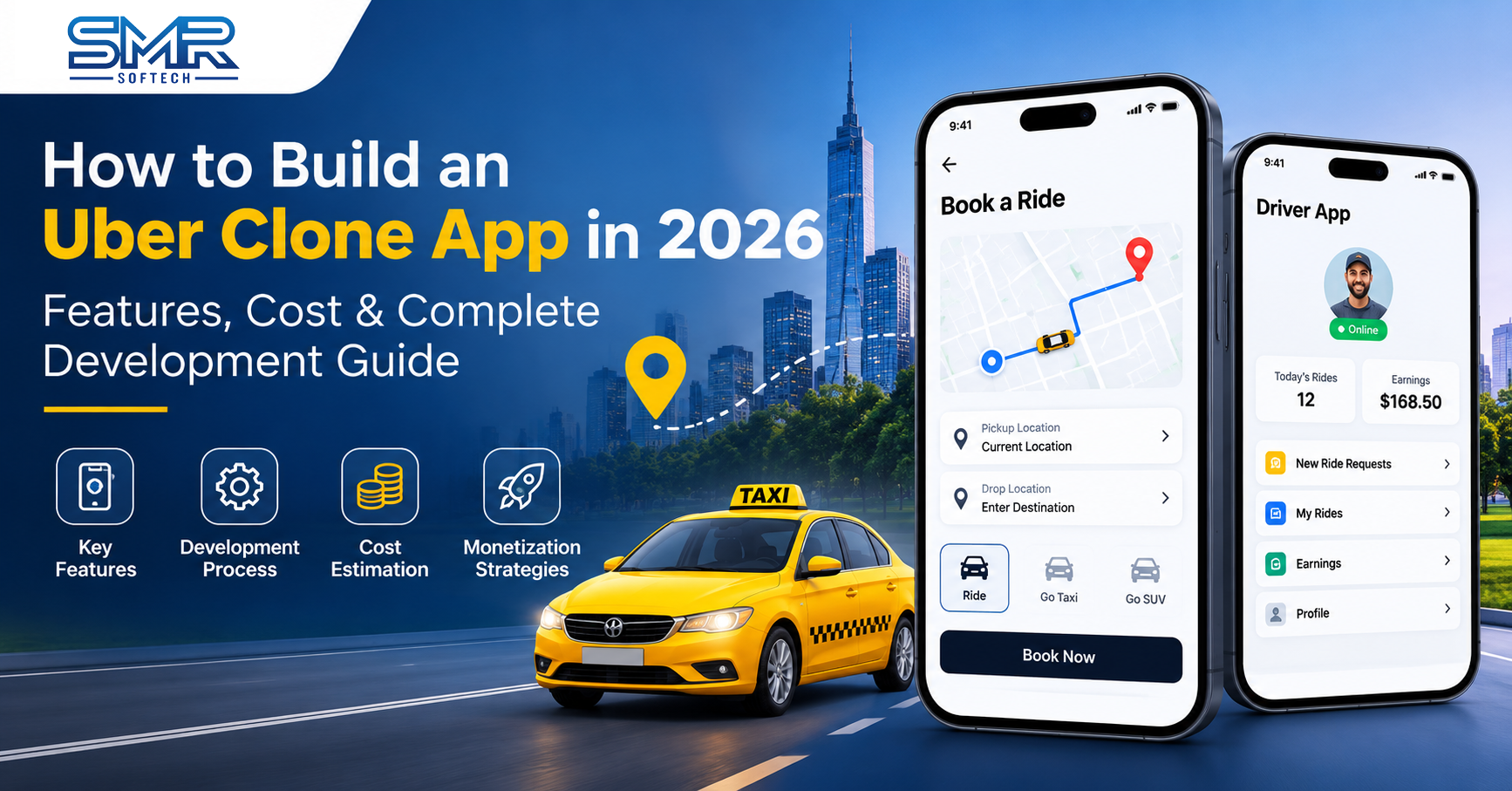
Most platforms have three major components: a passenger app, a driver app, and an administration dashboard. Some businesses also need a dispatcher panel, corporate booking portal, or fleet-owner interface.
Why Build a Taxi Booking App?
Digital booking can help taxi businesses accept requests, coordinate drivers, communicate estimated arrival times, and maintain records of completed trips. The commercial opportunity depends on local demand, competition, driver supply, operating costs, and applicable regulations; building an app alone does not guarantee growth or profitability.
- Branded customer experience: Offer booking under your own business identity.
- Operational visibility: Monitor trips, driver status, cancellations, and support cases.
- Flexible service models: Support local taxis, airport transfers, scheduled rides, or corporate travel.
- Data-informed decisions: Review booking patterns and service performance, subject to privacy requirements.
Essential Passenger App Features
Account Registration and Profile
Allow passengers to register through suitable authentication methods, manage contact details, and review trip history. Consider accessible design and clear privacy notices.
Pickup, Drop-Off, and Fare Estimates
Passengers should be able to select locations on a map, view eligible vehicle categories, and see an estimated fare before confirming a request. Actual fare rules must be communicated clearly.
Ride Booking and Live Trip Status
Show the booking state, assigned driver, vehicle details, estimated arrival, and trip progress. Location updates should be reliable without unnecessarily collecting data when the app is not in use.
Payments, Receipts, and Ratings
Depending on the market, support cash, cards, or local digital payment methods through compliant payment providers. Provide receipts, support access, and a fair ratings or feedback mechanism.
Essential Driver App Features
- Driver onboarding and document verification
- Online/offline availability and ride request alerts
- Accept, decline, and trip status actions
- Navigation and pickup instructions
- Trip earnings, commissions, and payout history
- Support, incident reporting, and safety features
Driver identity checks, vehicle licensing, and safety requirements differ by jurisdiction. Define these requirements before implementing onboarding and approval workflows.
Admin Dashboard and Dispatch Features
The administration dashboard is the operational center of a taxi booking platform. Common capabilities include:
- Passenger, driver, and vehicle management
- Driver approval and document review
- Ride monitoring, cancellations, and dispute handling
- Service zones, vehicle types, and fare configuration
- Commission settings, transaction records, and payout reconciliation
- Role-based access, audit logs, and reporting
A dispatcher interface may be valuable for phone bookings, manual ride assignment, airport queues, or fleets with centralized operations.
Technology Stack for Uber Clone App Development
The right stack depends on your team, budget, scale, and existing systems. One possible architecture uses Flutter for Android and iOS apps, Laravel for backend APIs and administration, and MySQL for relational data. Other frameworks may be appropriate after technical discovery.
- Mobile apps: Flutter or native Android/iOS development
- Backend: Laravel or another maintainable API framework
- Database: MySQL or PostgreSQL
- Maps and routing: A licensed mapping, geocoding, and directions provider
- Notifications: Push notification infrastructure with delivery monitoring
- Payments: Region-appropriate payment gateway integration
- Operations: Logging, monitoring, backups, and access controls
Real-time dispatch may require background jobs, queues, event broadcasting, and a carefully designed location update strategy. Plan for provider usage charges and data retention rules.
Step-by-Step Taxi Booking App Development Process
1. Validate Your Business Model
Identify your launch city, target customers, competitors, fleet supply, and pricing model. Check transport permits, insurance, labor rules, consumer protection obligations, and data privacy requirements.
2. Define an MVP
Prioritize passenger registration, booking, driver assignment, trip status, fare calculation, payment options, and a basic admin dashboard. Defer nonessential features until real user feedback supports them.
3. Design the User Experience
Map the full journey from pickup selection through ride completion. Prototype error states such as unavailable drivers, failed payments, GPS issues, and cancellations.
4. Build Apps, APIs, and Admin Tools
Develop the passenger and driver experiences alongside secure backend services. Apply authentication, authorization, rate limiting, encryption in transit, and server-side fare validation.
5. Integrate and Test
Test maps, dispatch, notifications, payment webhooks, location permissions, and edge cases on real devices. Perform security, accessibility, load, and recovery testing before launch.
6. Launch and Improve
Start with a controlled service area. Track booking completion, driver acceptance, cancellations, support response, and payment failures. Improve operations based on evidence rather than adding features indiscriminately.
How Much Does Uber Clone App Development Cost in 2026?
There is no universal price for an Uber-like app. The cost depends on the number of platforms, design complexity, dispatch requirements, integrations, security, testing, and maintenance. The ranges below are illustrative planning scenarios, not verified market averages or a quotation from SMR Softech.
| Project scope Illustrative development budget (USD)Typical scope | ||
| Lean MVP | $15,000–$35,000 | Core booking, driver workflows, basic admin |
| Custom regional platform | $35,000–$90,000 | Expanded dispatch, payment flows, reporting, custom UX |
| Complex multi-market platform | $90,000+ | Multi-region operations, advanced integrations, higher scale |
Actual quotes may fall outside these ranges. Hosting, mapping usage, SMS, payment processing, app store accounts, legal compliance, customer support, and ongoing maintenance are generally separate budget items. Request a requirements-based estimate before making financial commitments.
White Label Taxi App vs. Custom Development
White Label Solution
A white label platform can shorten the initial setup when its existing features fit your requirements. Review source-code ownership, licensing, security updates, data portability, vendor dependencies, and customization limits.
Custom Taxi Booking App
Custom development offers more control over dispatch logic, integrations, branding, and future product direction. It generally requires more planning, development, testing, and ongoing engineering responsibility.
The right choice depends on your launch timeline, operational requirements, and long-term ownership goals.
Taxi Booking App Revenue Models
- Per-trip commission: Retain a disclosed percentage or fixed fee per completed booking.
- Driver subscriptions: Charge a recurring platform access fee where lawful and commercially appropriate.
- Corporate accounts: Offer centralized billing and reporting for business travel.
- Fleet licensing: Provide dispatch software to independent fleet operators.
- Premium services: Offer scheduled airport transfers or higher-service vehicle categories.
Model unit economics carefully, including driver incentives, payment fees, insurance, refunds, support, and acquisition costs.
Why Consider SMR Softech for Taxi App Development?
SMR Softech provides software development services and a dedicated Uber clone app solutions page for businesses exploring ride-hailing platforms. When evaluating a development partner, discuss your required passenger, driver, and admin features; proposed technology stack; source-code terms; deployment plan; maintenance responsibilities; and project milestones.
For a scope discussion and tailored estimate, contact SMR Softech with your target markets, launch timeline, and must-have features.
Frequently Asked Questions
How long does it take to build an Uber clone app?
Timelines vary with scope, integrations, team capacity, and approval requirements. A tightly scoped MVP may take several months; complex platforms often require longer. Ask for a milestone-based delivery plan.
Can one codebase support Android and iOS?
Cross-platform frameworks such as Flutter can share substantial application code across Android and iOS. Platform-specific integrations, testing, and store approvals still require attention.
Do I need a driver app and admin dashboard?
Most two-sided ride-hailing services need both. The driver app handles ride execution, while the admin dashboard manages approvals, fares, support, and operational visibility.
Can I launch in multiple countries?
Yes, but multi-country operations add complexity around currencies, languages, payments, transport regulations, taxes, data protection, and service availability.
Is an Uber clone app legal?
Building a ride-booking platform is generally possible, but you must respect intellectual property rights and comply with the transport, consumer, employment, privacy, and payment rules in each operating market. Obtain qualified local advice before launch.
Conclusion: Build a Taxi App Around Real Business Needs
Successful Uber clone app development begins with operational planning, not just a feature checklist. Define your market, validate driver supply, choose a sustainable revenue model, and invest in dependable booking, dispatch, and support workflows.
Ready to explore a branded ride-hailing solution? Review SMR Softech's taxi app development offering and request a project consultation.
Planning a Website or Mobile App?
Talk with SMR Softech about your goals, project scope and development options.
Discuss Your Project →