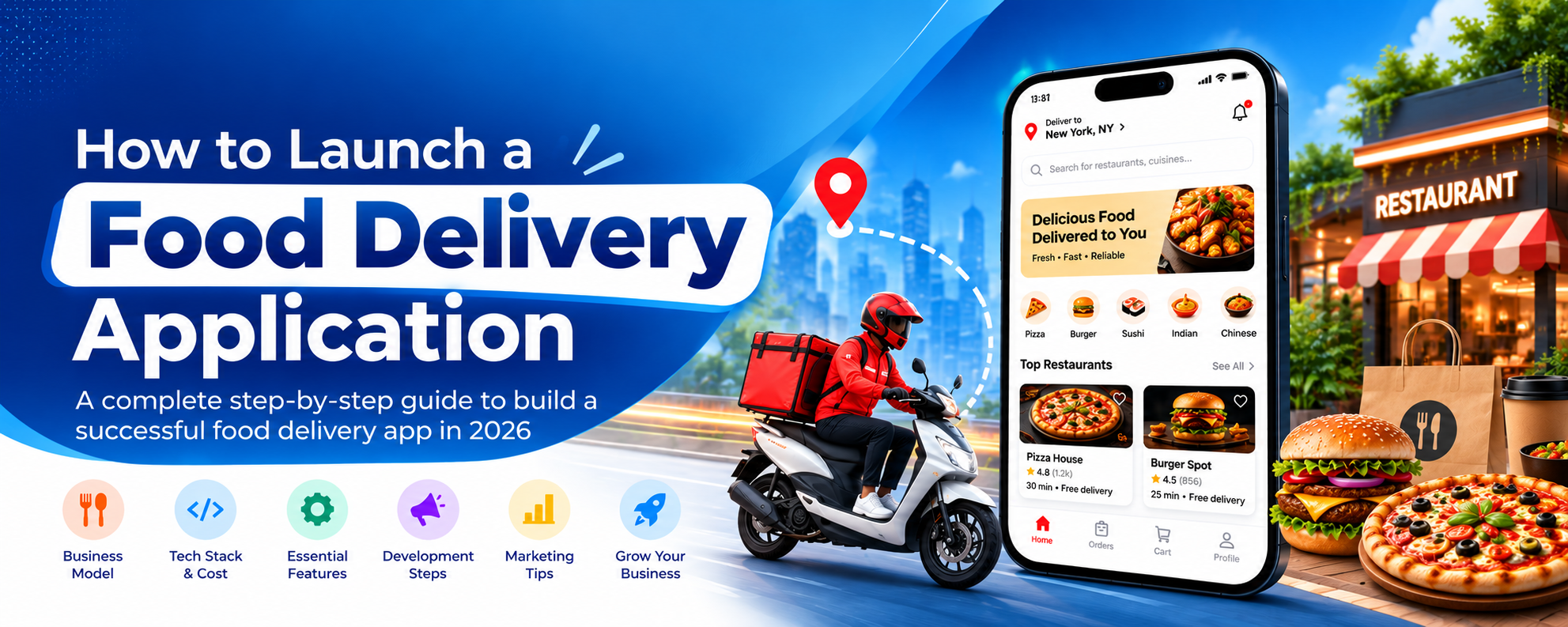
Launching a food delivery application in 2026 is an exciting opportunity for restaurants, startups, cloud kitchens, and entrepreneurs. With customers increasingly expecting convenient ordering, real-time tracking, secure payments, and fast delivery, a well-designed food delivery app can help businesses expand their reach and build lasting customer relationships.
Whether you want to create a restaurant ordering app, a multi-vendor food delivery marketplace, or a cloud kitchen delivery platform, this guide explains how to launch a food delivery application from planning to deployment.
1. Understand the Food Delivery Business Model
Before investing in food delivery app development, choose the business model that matches your goals, budget, and target audience.
- Single Restaurant Food Delivery App
A dedicated application allows one restaurant or restaurant chain to accept direct orders, manage menus, offer promotions, and build stronger customer loyalty without relying entirely on third-party marketplaces.
- Multi-Vendor Food Delivery Marketplace
A marketplace connects multiple restaurants with customers and delivery partners. The platform operator can earn revenue through restaurant commissions, delivery charges, advertising, and optional subscriptions.
- Cloud Kitchen Delivery Application
Cloud kitchens focus on delivery-first operations without traditional dine-in facilities. Their applications prioritize efficient order processing, kitchen workflows, and delivery coordination.
2. Research Your Target Market and Competitors
Successful food delivery applications solve specific customer problems. Before development, analyze your target location, customer expectations, restaurant availability, delivery distances, and competitors.
- Identify your target customers and their ordering habits.
- Research competing food delivery platforms and their pricing.
- Understand restaurant commission expectations and delivery costs.
- Evaluate demand for scheduled delivery, pickup, and subscriptions.
- Define your unique selling proposition, such as local cuisine, lower fees, or faster neighborhood delivery.
Validate your concept through customer interviews, restaurant discussions, and a limited pilot before expanding.
3. Choose the Essential Features of Your Food Delivery App
A complete food delivery platform typically includes customer, restaurant, delivery partner, and administrator interfaces.
Customer Application Features
- Easy registration and secure login
- Restaurant discovery and advanced food search
- Digital menus with customization options
- Shopping cart and seamless checkout
- UPI, card, wallet, and supported online payment options
- Order status updates and live delivery tracking
- Push notifications and promotional offers
- Ratings, reviews, and order history
- Customer support and refund request workflows
Restaurant Dashboard Features
- Restaurant profile and menu management
- Incoming order acceptance and preparation status
- Product availability and inventory controls
- Business hours and delivery zone configuration
- Sales reports, settlements, and promotional campaigns
Delivery Partner Application Features
- Delivery partner onboarding and verification
- Order assignment and acceptance
- Pickup and drop-off navigation
- Delivery status updates
- Earnings and payment history
Admin Panel Features
- Customer, restaurant, and delivery partner management
- Order monitoring and dispute resolution
- Commission, delivery fee, and tax configuration
- Coupon and promotional campaign management
- Analytics, reports, and role-based access controls
4. Select the Right Technology Stack
Your technology stack affects performance, development speed, maintainability, and future scalability. Choose technologies according to your product requirements and engineering team's expertise.
- Mobile application: Flutter or React Native for cross-platform development; Kotlin and Swift for native experiences.
- Backend: Laravel, Node.js, or another reliable backend framework.
- Database: MySQL or PostgreSQL for structured application data.
- Maps and location: Google Maps Platform or a suitable mapping provider.
- Payments: Razorpay, Stripe, or another provider supported in your operating market.
- Notifications: Firebase Cloud Messaging and appropriate transactional messaging services.
- Infrastructure: A cloud hosting environment with backups, monitoring, and scalable deployment options.
For a custom development strategy, visit SMR Softech to explore technology solutions for your business.
5. Design an Easy-to-Use Food Ordering Experience
User experience is critical to customer retention. Your application should help customers discover restaurants, customize meals, complete payments, and follow their orders without unnecessary steps.
Focus on clear navigation, fast-loading screens, readable menus, accessible buttons, transparent delivery charges, and a straightforward checkout process. Build responsive restaurant and admin dashboards that work efficiently across devices.
6. Develop a Minimum Viable Product (MVP)
Instead of launching every possible feature immediately, start with a minimum viable product. An MVP helps validate demand while limiting initial investment.
Your first version can include customer registration, restaurant listings, menu browsing, ordering, online payments, order status updates, a basic restaurant dashboard, delivery management, and an admin panel.
After collecting feedback, introduce loyalty programs, advanced recommendations, subscription plans, automated dispatch, and other features supported by real customer needs.
7. Integrate Secure Payments and Order Tracking
A trustworthy food delivery application needs reliable payment processing and transparent order updates. Integrate supported payment methods through a reputable payment gateway and avoid storing sensitive card details unnecessarily.
Implement appropriate authentication, encrypted communication, access controls, payment webhook verification, and transaction logging. Order tracking should clearly communicate stages such as confirmed, preparing, picked up, and delivered.
For payment security guidance.
8. Test the Application Before Launch
Thorough testing reduces operational problems and protects the customer experience. Test the complete ordering journey, including unsuccessful payments, canceled orders, unavailable menu items, delayed deliveries, refunds, and interrupted network connections.
- Functional and integration testing
- Android and iOS compatibility testing
- Payment and webhook testing
- Security and access-control testing
- Performance and load testing
- Usability and accessibility testing
- Restaurant and delivery partner workflow testing
Conduct a controlled pilot with a limited number of restaurants and customers before a wider release.
9. Understand Food Delivery App Development Costs
The cost of developing a food delivery application depends on the number of platforms, business model, interface complexity, integrations, security requirements, and development team.
A basic restaurant ordering MVP generally costs less than a full multi-vendor marketplace with separate customer, restaurant, delivery, and administrator applications.
When preparing your budget, include UI/UX design, development, testing, cloud hosting, payment processing fees, map API usage, maintenance, customer support, and marketing.
Request a requirement-based estimate rather than relying on a fixed price that may not match your project scope.
10. Launch Your Food Delivery Application
Once development and testing are complete, prepare your application for public release.
- Finalize restaurant partnerships and delivery coverage.
- Set up production hosting, monitoring, and backups.
- Prepare privacy policies, terms, and required business documentation.
- Submit mobile applications to Google Play and the Apple App Store where applicable.
- Train restaurants, support staff, and delivery partners.
- Launch initially in a manageable geographic area.
- Monitor orders, delivery performance, customer feedback, and technical issues.
For publishing requirements, consult Google Play Console and Apple's App Review Guidelines.
11. Market Your Food Delivery App and Grow Your Business
Launching an application is only the beginning. A sustainable food delivery business needs restaurant partnerships, customer acquisition, repeat orders, and efficient delivery operations.
- Optimize your website and restaurant landing pages for local SEO.
- Run location-targeted search and social media campaigns.
- Offer referral rewards and first-order promotions.
- Partner with local restaurants, influencers, and communities.
- Use permission-based email and push notification campaigns.
- Track repeat purchase rate, customer acquisition cost, order completion rate, and delivery performance.
Prioritize customer satisfaction and unit economics rather than relying only on discounts to generate growth.
12. Common Challenges in Food Delivery App Development
Food delivery platforms must coordinate customers, restaurants, and delivery partners in real time. Common challenges include delivery delays, order cancellations, inaccurate menus, payment failures, customer support demand, and peak-hour traffic.
Address these challenges with clear operational processes, reliable application architecture, transparent policies, accurate restaurant data, and ongoing performance monitoring.
Why Choose SMR Softech for Food Delivery App Development?
Building a food delivery platform requires careful product planning, intuitive design, dependable backend systems, and a scalable technology foundation.
SMR Softech can be your technology partner for discussing custom application requirements, restaurant management systems, user experience design, backend development, and business-focused digital solutions.
Whether you are planning a single-restaurant ordering system or a multi-vendor food delivery marketplace, start by defining your business goals, essential features, and launch strategy.
Ready to build your food delivery application? Visit SMR Softech to discuss your project and explore a solution tailored to your business.
Frequently Asked Questions
How do I start a food delivery application business?
Start by researching your target market, choosing a business model, partnering with restaurants, defining core features, developing an MVP, testing operations, and launching in a limited area before scaling.
How much does it cost to develop a food delivery app?
Development costs vary based on the number of applications, custom features, integrations, technology choices, and complexity. A detailed project scope is necessary for a reliable estimate.
How long does it take to build a food delivery application?
A relatively simple MVP may take several months, while a complex marketplace with multiple applications and integrations can take considerably longer. Timelines depend on requirements, team capacity, and testing.
Which technology is best for food delivery app development?
Flutter and React Native are common cross-platform mobile options. Laravel and Node.js are potential backend choices, while MySQL and PostgreSQL can support structured platform data. The right combination depends on your requirements.
Can I launch a food delivery app for a single restaurant?
Yes. A single-restaurant application can support direct ordering, menu management, payments, promotions, and delivery updates without requiring a multi-vendor marketplace.
What features should a food delivery app MVP include?
Prioritize restaurant listings, menu browsing, cart and checkout, payments, order management, delivery updates, and basic administrative controls.
Conclusion
Learning how to launch a food delivery application involves much more than building a mobile app. Success depends on market research, the right business model, essential features, secure technology, reliable delivery operations, and consistent marketing.
Start with a focused MVP, validate the experience with real users, and improve your platform based on measurable results. With a clear development roadmap and the right technology approach, your food delivery business can build a strong foundation for sustainable growth.
Explore custom digital solutions at SMR Softech and take the next step toward launching your food delivery application.
Planning a Website or Mobile App?
Talk with SMR Softech about your goals, project scope and development options.
Discuss Your Project →